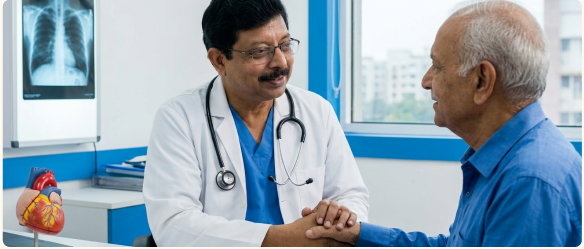
A patient story from Dr. Apurba Kumar Sarma’s practice
Quick Takeaways
- Quadruple coronary artery bypass graft (CABG x4) bypasses all four major diseased coronary arteries in a single operation – it is among the most significant interventions in cardiac surgery, but not the most unusual
- Bypass surgery performed at the right time, in the right hands, does not shorten life – for many patients, it restores decades of active, full living
- Solaiman had his surgery at 39 years old. At 58, nineteen years later, he is well enough to travel to his follow-up appointment and smile for a photograph
- Dr. Apurba’s relationship with Bangladeshi patients spans two decades – built during his 13 years building cardiac surgery in Dhaka, maintained to this day
In March 2024, a man named Solaiman walked into Dr. Apurba’s consulting room in Dhaka.
He was 58 years old. He weighed 65 kilograms. His blood pressure was 110 over 70 – controlled, stable, unremarkable. He had hypertension and diabetes, both managed with medication. He was there for a follow-up.
The last time he had needed Dr. Apurba urgently, he was 39.
Solaiman was a relatively young man in February 2005 when he was told that four of the major arteries supplying blood to his heart were significantly diseased. He was 39 years old. He had hypertension. He had diabetes. And the coronary angiogram, which had been ordered because of symptoms he had been managing and minimising for longer than he should have, showed the full picture: multivessel coronary artery disease, with all four major vessels involved.
Four-vessel coronary artery disease is not rare in South Asia – the combination of genetic predisposition, diabetes, and hypertension creates a pattern that cardiologists and cardiac surgeons in Bangladesh and India recognise with a particular kind of gravity. It is not a condition to manage with medication alone. It is a condition that needs bypass surgery.
Solaiman needed a quadruple bypass – CABG x4.
In the operation that followed, Dr. Apurba created four new pathways for blood to reach the heart, bypassing each of the blocked segments. The left internal mammary artery – the gold-standard conduit, taken from inside the chest wall – was routed to the Diagonal branch. Three vein grafts, taken from the leg, were used to bypass the Left Anterior Descending artery, the Diagonal Marginal, and the Posterior Descending Artery. Four vessels addressed. Four new channels for blood to travel freely where it had been struggling.
The LIMA-to-LAD graft – or in this case, LIMA to the Diagonal – is the one that matters most for longevity. Studies consistently show these arterial grafts remain open in more than 90% of patients at ten years. For a 39-year-old man, that graft was not just a surgical repair. It was, potentially, decades.
He was that patient.
Bypass surgery at 39 does not end a life. It gives one back.
But it requires something in return: a patient who takes the second chance seriously. Solaiman had two conditions – hypertension and diabetes – that, if poorly controlled, would work against the grafts over time and raise the risk of further cardiovascular events. He knew this. He managed them.
In 2008, he had a femur fracture – a completely unrelated injury, managed surgically, revised in 2009. The orthopaedic team noted the cardiac history and worked accordingly. His heart held through both procedures without incident.
His blood pressure. His medications. His follow-up appointments. For nineteen years, he attended to the machinery that had been repaired in 2005 and asked to last a lifetime.
In March 2024, his blood pressure was 110/70. His pulse was 75. Those are not the numbers of a man whose heart has been failing quietly. Those are the numbers of a man who has been taking care of himself.
Dr. Apurba reviewed Solaiman’s clinical history. He noted the original surgery – February 2005, the grafts, the vessels addressed. He noted the hypertension, the diabetes, the orthopaedic history. He ordered what any thorough follow-up requires: blood work including HbA1c (the three-month average of blood sugar control), fasting lipid profile, kidney function, ECG, and an echocardiogram.
The investigations would give a current picture of the heart – how the grafts were functioning, whether the ejection fraction had changed, whether any new territory had become vulnerable. They would inform the next chapter of management.
This is what long-term cardiac care looks like in practice. It is not a single dramatic intervention followed by silence. It is a relationship – a surgeon and a patient, returning to each other, reviewing what is working, catching what might be changing early enough to matter.
Solaiman has that relationship. He has had it for nineteen years.
At the end of the consultation, he and Dr. Apurba stood together for a photograph. Solaiman is in a white salwar kameez. He is smiling.
He does not look like a man who was told, at 39, that four of the arteries feeding his heart were blocked.
He looks like a man who is 58, and well, and has places to be.
The narrative of bypass surgery, in the public imagination, tends to stop at the operation. The dramatic part – the diagnosis, the fear, the surgery, the recovery – fills the story. What comes after is quieter and less often told.
What comes after, when the surgery works and the patient does their part, is life.
Nineteen years of it for Solaiman. A femur fracture managed and recovered. Blood pressure controlled. Diabetes managed. Follow-up appointments kept. And in March 2024, a consultation in Dhaka where the most notable thing about the clinical record was how stable it was.
This is not a coincidence. It is the outcome of bypass surgery performed at the right time, by a surgeon with the skill and experience to do it correctly, on a patient who understood what the surgery gave him and chose to honour it.
Dr. Apurba operated on Solaiman in 2005, at the beginning of his Bangladesh chapter – the years when he was building cardiac surgery programmes in Dhaka from the ground up. Solaiman was one of thousands of patients from those years. He is also one of the patients who has come back. Not because something went wrong, but because the relationship he built with his surgeon is one he has chosen to maintain.
That is a particular kind of trust. It is earned over nineteen years, not promised in a brochure.
Solaiman underwent quadruple coronary artery bypass grafting (CABG x4) and has been under the long-term cardiac care of Dr. Apurba Kumar Sarma. His story is shared with his consent.
If you or a family member has been told you need bypass surgery – or if you are a previous cardiac surgery patient who has not had a recent follow-up – Dr. Apurba and his team at Tulip Mediworld Superspeciality Hospital, Guwahati are available for consultations. Bangladeshi patients are seen regularly. Call 1800 890 4655 or visit drapurbasarma.in.
Medical Disclaimer: This article is for informational purposes only and does not constitute medical advice. Please consult a qualified cardiac surgeon for evaluation and treatment specific to your condition.