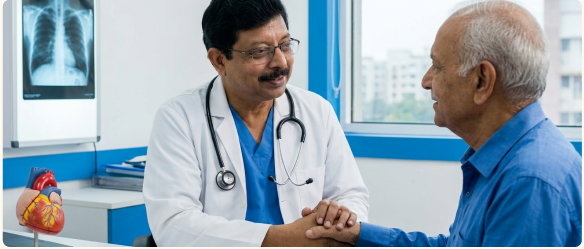
A patient story from Dr. Apurba Kumar Sarma’s practice – Tulip Mediworld Superspeciality Hospital, Guwahati
Quick Takeaways
- Double vessel coronary artery disease (two-vessel CAD) requires bypass surgery when stenting is not the right answer – which it frequently isn’t
- Patients in Assam no longer need to travel to Delhi or Chennai for bypass surgery – world-class CABG is available at Tulip Mediworld, Guwahati
- Early symptom recognition – chest tightness, breathlessness on exertion – is what gave Ranjit Borah his outcome. He did not wait for a heart attack
- Recovery after bypass surgery, with the right support, allows most patients to return to a full, normal life within 3 months
Ranjit Borah runs a hardware business in Guwahati’s Fancy Bazar. He has run it for 31 years – the kind of business built one relationship at a time, where suppliers know your name and customers become friends. A man used to being on his feet, on the phone, doing.
So when the breathlessness started, he noticed it. But he did not stop.
“I thought it was my weight,” he says. “I thought it was my age. I told myself I just needed to lose a few kilos and it would pass.”
For six months, he told himself this. And for six months, his body disagreed.
The breathlessness was not dramatic. That is often how heart disease presents – not with the crushing chest pain of the films, but with something quieter. A heaviness climbing the stairs to his shop’s first floor. A tightness in the chest after a heavy meal. A sense of effort where there had been none before.
Ranjit was 57 at the time. He had high blood pressure – managed with medication for five years. His father had died of a heart attack at 64. Both of these facts had been sitting in the back of his mind without quite reaching the front.
It was his wife, Bina, who made the appointment.
“She told me – you are describing your father. Go. And I went.”
His cardiologist in Guwahati ordered an ECG and an echocardiogram. The echo showed that the pumping function of his heart – the ejection fraction – had mildly reduced. There was something going on. A stress test followed. The result was abnormal. A coronary angiogram was arranged.
The angiogram told the story clearly: two of the three major arteries supplying Ranjit’s heart were significantly narrowed. The Left Anterior Descending artery – the most critical vessel, responsible for supplying the heart’s largest pumping chamber – was 80% blocked. A second major branch, the Right Coronary Artery, was 70% blocked.
Two-vessel coronary artery disease. Significant, symptomatic, and in a patient with a family history of early cardiac death.
His cardiologist reviewed the angiogram films with him. Then she said the words Ranjit had not been expecting.
“She said – you need bypass surgery. You need to go to Delhi.”
The recommendation to travel was automatic. For decades, it had been the only option – if you lived in Guwahati and needed complex cardiac surgery, you packed a bag.
Ranjit started asking questions. What would it cost, all in – the surgery, the accommodation, the time away from the shop? Who would look after his mother, who was 82 and unwell? How long would he be away?
The numbers began to stack up in a way that felt impossible. Not just the money – the logistics. The family. The business.
A friend who had been through something similar mentioned a name: Dr. Apurba Kumar Sarma. A cardiac surgeon who had trained at one of India’s top institutes, spent years in Bangladesh, and had returned to Guwahati to build his own cardiac hospital.
“I did not know you could have bypass surgery in Guwahati,” Ranjit says. “I genuinely did not know.”
Ranjit brought his angiogram films, his echo report, his ECG, and his list of medications to his first appointment with Dr. Sarma.
“He looked at everything. He didn’t rush. He asked me about my work, my daily routine, how far I was walking before the breathlessness started. I remember thinking – this is not what I expected.”
Dr. Sarma reviewed the angiogram carefully. His assessment was direct: both blocked arteries needed bypass grafts. The left internal mammary artery – a vessel from inside the chest wall – would be used for the critical LAD graft. A vein graft from the leg would address the right coronary artery.
He explained, in plain terms, why surgery was preferable to stenting for Ranjit’s anatomy. The LAD lesion – the 80% blockage in the most important artery – was long and involved a segment that stents do not treat as durably as a bypass graft. For a 57-year-old man with a family history of heart disease, a graft that would last twenty years was a better answer than a stent that might need revisiting in five.
“He told me what he was going to do, and why, and what to expect after. By the end, I wasn’t scared. I was ready.”
Surgery was scheduled for the following week.
Ranjit’s double bypass surgery was performed by Dr. Sarma at Tulip Mediworld Superspeciality Hospital on a Tuesday morning in February. The procedure lasted approximately four hours.
In a double coronary artery bypass graft, two new conduits are created to bypass the two blocked coronary arteries. The left internal mammary artery – harvested from inside the chest wall while keeping one end attached – is sewn to the left anterior descending artery beyond the blockage, restoring full blood flow to the heart’s main pumping territory. A second graft, typically a segment of the great saphenous vein from the leg, is used to bypass the second blocked vessel.
The LIMA-to-LAD graft is the gold standard in bypass surgery – studies consistently show it remains open and functioning in more than 90% of patients at ten years. For a patient like Ranjit, it was the durable, long-term restoration of blood flow his heart needed.
He spent the first 36 hours post-operatively in Tulip Mediworld’s cardiac ICU. He was monitored continuously. On day two, he was moved to the ward.
“I remember opening my eyes in the ICU and thinking – I can breathe. Properly. I could not remember the last time breathing felt like nothing at all.”
Ranjit was discharged from Tulip Mediworld on day seven. He came home to his family, to his mother, to the neighbourhood where he had spent his entire life.
The recovery was not without effort. The sternum – the breastbone, divided during surgery – takes six to eight weeks to fully heal. He could not drive. He could not lift. He walked, slowly at first, building up a little more each day.
“Dr. Sarma’s team gave me a very clear list of what I could and could not do, week by week. Every time I was unsure about something – whether I could climb stairs, when I could go back to the shop – I called, and someone answered.”
At six weeks, he returned to Tulip Mediworld for his follow-up. The wound had healed cleanly. His echo showed improved heart function. His breathlessness had gone.
At three months, he was back in Fancy Bazar.
Ranjit Borah walks 4 kilometres every morning before the shop opens. His blood pressure is controlled. His medications have been reviewed and adjusted. He has not had a single episode of chest tightness since surgery.
His mother was there when he came home from hospital. He did not miss a day of her care.
“People ask me – was it a big deal, the surgery? And the honest answer is yes. It was a big deal. But it was a big deal that happened in Guwahati, with my family nearby, in a hospital where I felt like a person and not a file. I did not go to Delhi. I did not need to.”
He is 58 now. He intends, he says with some firmness, to be running his business at 78.
Ranjit Borah underwent double coronary artery bypass grafting (CABG x2) performed by Dr. Apurba Kumar Sarma at Tulip Mediworld Superspeciality Hospital, Guwahati. His story is shared with his consent.
If you or a family member has been told you need bypass surgery – in Guwahati, in Assam, or anywhere in Northeast India – a consultation with Dr. Sarma at Tulip Mediworld may mean you do not need to leave home. Call 1800 890 4655 or visit drapurbasarma.in.
Medical Disclaimer: This article is for informational purposes only and does not constitute medical advice. Please consult a qualified cardiac surgeon for evaluation and treatment specific to your condition.