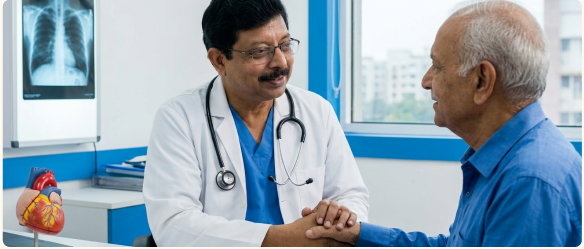
A patient story from Dr. Apurba Kumar Sarma’s practice – Tulip Mediworld Superspeciality Hospital, Guwahati
Quick Takeaways
- Triple vessel coronary artery disease – three major arteries blocked – requires bypass surgery, not stenting, for the best long-term outcome, especially in diabetic patients
- A prior heart attack and diabetes do not disqualify a patient from bypass surgery – they make the surgery more complex, but in experienced hands, they are manageable
- Habibur Rehman had his triple bypass in 2014 at age 63, with diabetes and a heart attack already on his record. He is 73 now. He is well.
- The LIMA-to-LAD bypass graft – the gold-standard conduit in bypass surgery – remains open in more than 90% of patients at ten years. Habibur’s is one of those.
Habibur Rehman is a practical man.
He is devout, dignified, unhurried in the way that comes from having lived through enough to know what actually requires urgency. He has lived in Bangladesh his entire life. He has managed his diabetes for years with the careful, unglamorous discipline that long-term disease management demands: medications, diet, monitoring, the same small commitments every day.
When his chest started to trouble him – a heaviness, a fatigue that sat just behind the sternum, a breathlessness on exertion that had not been there before – he noticed it. He did not make a fuss about it. But he noticed.
He had noticed before. He had already survived a heart attack.
Habibur was in his early sixties when his heart first made itself known with force – an acute heart attack that announced, plainly, that the arteries supplying his heart had been struggling for some time. He recovered. He adjusted his medications. He carried on.
But the body, after a heart attack, carries the record of it. The scarred patch of heart muscle. The arteries that narrowed once and will, in the right conditions, narrow further. The diabetes that had been silently accelerating plaque formation in his arterial walls for years – because that is what poorly controlled blood sugar, over time, does to coronary arteries. It hardens them. It narrows them. It sets the conditions for exactly the kind of disease that was quietly progressing in Habibur’s chest.
He was also managing dyslipidemia – elevated fats in the blood – a second driver of the same process. Diabetes plus dyslipidemia plus a prior heart attack is not a combination that resolves quietly with medication alone. It is a combination that requires close monitoring, regular investigation, and the willingness to act decisively when the investigation tells you something that cannot be managed conservatively any longer.
The investigation eventually did exactly that.
Habibur’s coronary angiogram – an X-ray of the arteries with contrast dye injected to show the blockages – revealed what his symptoms had been pointing toward.
Three of the major coronary arteries were significantly narrowed. The Left Anterior Descending artery, the Obtuse Marginal branch, and the Posterior Descending Artery – the three main channels through which the heart muscle receives its blood supply – were all affected.
Triple vessel coronary artery disease.
In a healthy heart, these vessels deliver oxygenated blood to every part of the pumping muscle, 100,000 times a day, without rest. When all three are narrowed, the heart is effectively working against a permanent shortage. Every beat is performed under conditions of reduced supply. The risk of further heart attack, of progressive heart failure, of a sudden cardiac event – all of it rises substantially.
For diabetic patients with triple vessel disease, the evidence from large cardiac trials is unambiguous: coronary artery bypass grafting (CABG) provides significantly better long-term protection than stenting alone. The grafts bypass the blocked segments entirely, creating new routes for blood flow that are not subject to the same narrowing. For Habibur, this was not a choice between two equivalent options. Bypass surgery was the right answer.
“He explained it to me clearly,” Habibur says. “He told me what was blocked, why the surgery was better than a stent for my situation, and what he was going to do. By the time I left the consultation, I understood. I said – then do it.”
Surgery was scheduled for June 5, 2014.
The procedure was performed by Dr. Sarma. Three bypass grafts. Three new routes for blood to reach the heart muscle that the narrowed arteries could no longer reliably supply.
The left internal mammary artery – a vessel from inside the chest wall that remains one of the most durable conduits available in cardiac surgery – was carefully harvested and sewn to the Left Anterior Descending artery beyond the blockage. This is the LIMA-to-LAD graft, the gold standard of bypass surgery: studies consistently show it remains open and functioning in more than 90% of patients at ten years. For a man with Habibur’s risk profile, it was the cornerstone of the repair. Two further vein grafts, taken from the leg, were used to bypass the Obtuse Marginal and Posterior Descending Artery.
Three vessels. Three grafts. Four hours in the operating theatre.
The complexity of the case – diabetes, a prior infarct, the age of the patient – demanded precision that comes from doing this many times, across many years, on patients whose situations are never exactly alike. Dr. Sarma has performed more than 7,000 heart surgeries across 25+ years of practice. High-risk cases are not exceptional to him. They are part of the work.
Habibur came through the surgery. He was moved to the ICU. He was monitored closely. And then, slowly, the heart that had been struggling for years began to receive its blood supply through clean, unobstructed channels.
“I woke up and I could breathe,” he says. “The heaviness was gone. I had forgotten what that felt like.”
Habibur was discharged and returned to Bangladesh. The recovery was not without effort – the sternum takes six to eight weeks to fully heal, and a man who has spent his life being self-sufficient does not find the restrictions easy. He could not drive. He could not lift. His wife watched him carefully.
But he followed the instructions. He took his medications – the regimen that manages his heart, his blood pressure, his blood sugar, his lipids – with the same quiet discipline he had brought to his diabetes management for years. He walked, a little more each week. He returned for his follow-up appointments.
The heaviness did not come back.
The photograph in this story was taken at a follow-up consultation in 2024.
Habibur Rehman is 73 years old. He is standing upright, composed, next to Dr. Sarma. He is well.
Ten years after triple bypass surgery, on a diabetic patient who had already sustained a heart attack before he ever arrived at the operating table – this is not a result that can be taken for granted. It is the outcome of a surgery performed correctly, on a patient who understood what the surgery gave him and chose, every day for a decade, to look after it.
He is still on his medications. He still reviews with Dr. Sarma. His next appointment is in six months.
“People ask me – was the surgery worth it?” he says. “I am 73. I am here. What kind of question is that?”
There is a particular kind of fear that settles on a patient who has already had one heart attack, who has diabetes, who is in his sixties, and who is told he needs three bypasses. The fear is not irrational. The surgery is significant. The risk factors are real.
But the fear is also, in cases like this, the wrong lens.
The question is not whether surgery carries risk. The question is what happens without it – in a diabetic patient with three blocked coronary arteries and a heart that has already been through one attack. The answer to that question, from the clinical evidence and from a decade of Habibur’s life, is clear.
The surgery did not end his story. It gave him a decade more of it.
He is 73. He is counting.
Habibur Rehman underwent triple coronary artery bypass grafting (CABG x3) performed by Dr. Apurba Kumar Sarma. His story is shared with his consent.
If you or a family member has been told you need bypass surgery – particularly if you have diabetes, a prior heart attack, or multiple vessel disease – a consultation with Dr. Sarma at Tulip Mediworld may be the most important call you make. Call 1800 890 4655 or visit drapurbasarma.in.
Medical Disclaimer: This article is for informational purposes only and does not constitute medical advice. Please consult a qualified cardiac surgeon for evaluation and treatment specific to your condition